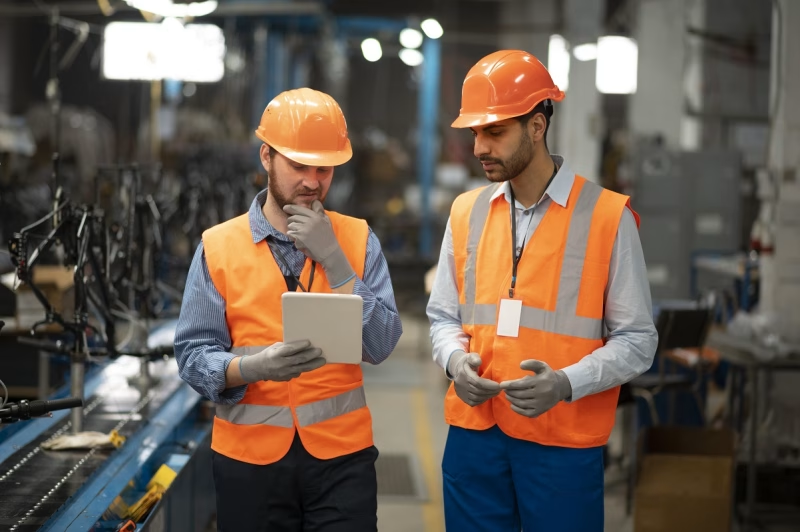
An electrical equipment cabinet fabricator in Maharashtra, of average enterprise size, bought the machine after having obtained it from an unconfirmed manufacturer vendor, which was a 200-ton-capacity press brake. The paperwork and specs seemed fine: very high tonnage, simple two-axis control, and a price tag only 25% less compared to the market. The plant manager faced the worst-case scenario three weeks into non-stop production. A deviation of the 1.5-degree angle was the issue over the entire three-meter 3mm stainless steel bend. The system of the gauge on the back was drifting by almost 0.5mm fifty times, and the operators spent a lot of time making small adjustments to the materials to compensate for the warping of the machine. The number of rejected products increased to 12%, the production lines stalled, and finally, the savings through the low price became a total loss with the wasted metal sheets.
This kind of scenario occurs a lot in metal fabrication workshops in different parts of the country. Buying heavy industrial machines has to be done with an eye on more than only the purchase price at first glance.
Sheet metal bending is a process that demands a lot of attention and precision. Even small frame deformations, pressure fluctuations in the fluid, and unsynchronized machine components can be causes of the dimensional changes of your metal products.
In a span of years, the domestic machine tool builders have really improved themselves in engineering and production. For purchasing engineers who have to choose from complicated investment decisions for large capital equipment, partnering with reputable press brake manufacturers India could be the direct way to achieving precise machining, limited breakdown times, and robustness of the operations over time.
What Is the Modern Bending Revolution in Sheet Metal Fabrication?
The artistry of bending metal sheets once belonged mainly to mechanical types of press brakes with very simple NC hydraulic controls.
Back then, it mostly relied on hands-on methods like manually guessing and changing, and setting up shims as per the operators’ gut feeling to get the desired bending angles. The tensile strength variability of metals, which was even visible in metal rolls supplied by the same steelmaker, caused unexpected bending of the metal sheets, making the bending angle of the same component vary a lot.
Today, the fabrication process involves a lot more, such as close dimensional control (tight tolerancing), the development of very complex multi-bend shapes, and accurate repeating of features as small as a fraction of a degree.
The modern bending wave is a change from the previous ones, and now the focus is entirely on using high-precision CNC (Computer Numerical Control), electro-hydraulic synchronization, hybrid drive technologies, and totally electric servo press brakes.
New-age machines use two valves that are controlled and adjusted separately in a proportional manner to operate the twin cylinders Y1 and Y2 of the axis. The machine monitors the motion of the ram very precisely by using linear optical encoders. This machine is capable of mechanically/hydraulically crowning to compensate for the beam deflection during operation. The modern press brake is very effective and ensures a uniform angle even on the biggest sheet metal items.
Why Sourcing from Press Brake Manufacturers India Matters in Industrial Procurement
The decision to buy heavy machinery equipment is a big one for factory productivity and will influence, to some degree, maintenance costs and the quantity of the product that can be made year after year.
The equipment to bend metals is indispensable to industries such as the production of metal car bodies and chassis for the automotive industry, fabrication of the covers and panels for electrical cabinets, HVAC duct systems, structural steel, elevator cabins, and the fabrication part of Earth-moving Machinery industries.
In addition to a clear picture of their technical upgrading capability, the Press Brake Manufacturers India help customers assess how their machines will behave in terms of cost-benefit for a lifetime, which includes initial costs and maintenance costs.
1. Reducing Scrap and Rework Costs
An inconsistent two-bend angle per cent scrap is a huge raw material waste in high-volume manufacture. The high-precision CNC press brakes that integrate automated angle measuring devices are able to prevent the first-product trial bends. The operator inputs the DXF drawing on a CNC system, does a simulation on the offline software, and then he or she gets a perfect first article produced on the first cycle.
2. Operational Energy Efficiency
Older hydraulic press bends run on running pumps continuously. They take full electrical load even when they stand idle, or when no load is fed. Present-day hybrid and servo-electric press brakes only run their power during the actual bending motion. Hence, energy consumption can be cut down by 50-70 percent, which is going to be a significant utility cost saving, particularly in big-scale metal fabrication operations.
3. Supply Chain Agility and Spare Parts Availability
European and East Asian imported machines sometimes come with very long delays in delivering replacement components. If a proportional valve, encoder, or controller PCB malfunctions on an imported machine part, a delay of several weeks in air-freight of replacement parts will halt the production line. Local machine manufacturers keep component reserves; service engineering support is local, and on-site rapid support is available across major industrial corridors.
Key Technical and Commercial Factors Procurement Teams Must Evaluate
Evaluating a press brake should be an effort to convert production requirements into exact machine requirements. Buying machinery that exceeds needed specifications will result in an unnecessary capital expenditure; getting machinery less powerful than needed will result in rapid frame fatigue, constant overload tripping, and out-of-spec components.
Manufacturers of Press Brakes in India who are leading the field, when providing their machine details, mention multi-axis back gauges, advanced CNC controls, and solid frames engineered to withstand very tough industrial environments.
Material and Technical Specifications
- Tonnage Calculation: Don’t rely on merely an average plate thickness to choose a machine’s tonnage. You should use a formula to calculate the tonnage requirement considering the thickest material, the longest bend, the strongest tensile material (e. g., SS 304 or Hardox), and the bend inside radius as a reference. To be safe, add a 20-25% margin on top of the calculated highest requirement to operate the hydraulic system at max pressure continuously.
- Bed Length and Distance Between Frames: Check that the machine will suit the sheet length needed by you. When you want to make long parts by letting them go completely through the back of the machine, determine the clear distance between side housings (frames).\
- Stroke Length and Open Height (Daylight): Deep channels, high-precision boxes, or tall tooling setups will require high-daylight height and enough ram stroke to avoid difficulties when removing deep box parts after forming. Insufficient daylight will limit your capabilities.\
Drive Systems: Hydraulic, Servo-Electric, or Hybrid?
- Conventional Electro-Hydraulic Press Brakes: These are the best choice for high-tonnage heavy plate bending (160 tons to 1000+ tons). They offer high force output at a low capital cost; however, hydraulic oil maintenance and heat generation have to be considered.
- Servo-Electric Press Brakes: These are perfect for precision, thin-to-medium gauge sheet metal work (up to 100 tons). They do not make use of hydraulic oil at all, so there are no environmental leakages; there is a very rapid cycle rate, they possess a repeatable positioning accuracy ($\pm 0.005 ext{ mm}$), and they are very quiet during running.
- Hybrid Press Brakes: A powerful hydraulic force is delivered together with a low volume of oil and a reduced requirement of electric energy. Therefore, they combine the advantages of servos and hydraulics.
CNC Controls and Back Gauge Axes
The level of intricacy in your sheet metal components determines the type of controlling system required:
Press Brake Machines
- Standard 3-Axis (Y1, Y2, X): Sufficient for basic single-axis back gauge movements and simple bend operations.
- 4-Axis to 6-Axis (Y1, Y2, X, R, Z1, Z2): Essential if height (R-axis) must be adjusted and back-gauge (Z1, Z2-axes) can be set independently without manual interference of the operator.
- Graphical 3D Controllers: Enable programming off-line, auto-sequencing, collision detection, and import of DXF files at the machine station.
How to assess Press Break Manufacturers Suppliers India –
To get a clear picture of the capabilities of Press Break manufacturers in India through a supplier audit process, one should move beyond attractive product brochures and focus on the manufacturing core engineering, quality control facilities, and technical support capabilities of the company.
1. Design of Machine Frame and Relaxation of Stress
The rigidity of side frames, upper bed, and lower ram of the machine defines the bending accuracy over time. Ask if the company uses high-tensile structural steel plates in making the frame. Inquire also about whether the machine frame is stress-relieved through furnace (thermal stress relieving) or by a mechanical stress-relieving process after welding only. Frames that are not stress-relieved can be deformed under repeated heavy cycles, and thereby misalignment of the machine is an inevitable result.
2. Suppliers of Main Components
Pioneering machine builders combine the usage of top global components with their own fabrication:
- Hydraulic valves: Bosch Rexroth or Hoerbiger.
- CNC Controllers: Delem, Cybelec, or ESA.
- Linear Encoders: Heidenhain or Givi Misure.
- Electric System: Schneider, Siemens, or ABB.
A manufacturer from India who makes use of top-level international components (hydraulics and CNC) will definitely provide the perfect match: world-class accuracy of components combined with Indian fabrication of structure plus swift on-site service from locals.
3. Inspection Process and Quality Control
Ask the vendor for a copy of their factory acceptance test (also known as FAT) protocol. In a detailed testing process, the following are included:
- Laser Interferometer Testing: To evaluate ram positioning and axis repeatability.
- Whole Machine Bending Accuracy Test: The machine’s ability to maintain a certain bend across its complete working space.
- Hydraulic System Endurance Test: Running the hydraulic system at full capacity for a considerable time.
Mistakes commonly made by procurement teams while selecting vendors
Wasting budget on overkill tonnage at the expense of back-gauge flexibility
Purchasing a heavy machine only to be able to do one thing, e.g., 2 mm mild steel sheets, and yet a 300-ton press is bought; that will only increase costs and waste energy through the longer time cycle. Moreover, the machine’s heavy die opening can result in the flange being too small. A machine of the right size (tonnage) will allow budget reallocation towards a multi-axis back-gauge or auto-crowning system.
Failure to consider Tooling Compatibility and Clamping
Making the machine frame is only half the story; bending accuracy will be only via tooling. Standard/manual screw clamping has an obvious disadvantage of being slow, especially while switching jobs. So a plant that is mainly into short-run productions and requires frequent tool changes, the request should include hydraulic, pneumatic clamping of the tool quickly plus the hardened, segment tooling that is precision-ground for example of Promecam/Amada or Wila.
Ignores Technical Support After Purchase
A low-cost machine purchase by companies without any regional fabricator with the support of a separate service branch can result in very lengthy machine downtime. A malfunction such as the main cylinder seal leakage or an encoder calibration issue would result in the lack of experienced technical service that could not only handle the problem with the equipment, but would also cause long factory outages for a couple of weeks.
Navigating the Indian Market: Clusters, Standards, and Logistics
The domestic machine tool industry has successfully established major manufacturing clusters throughout the country:
- Western Region (Pune, Ahmedabad, Rajkot): Machine tool manufacturers of this region are renowned for machine design, integration of heavy hydraulics, and fabrication of structural products at high specialty.
- Southern Region (Bengaluru, Coimbatore, Chennai): Machine builders here excel in producing high-quality, precise, CNC-controlled machines and systems with servo-electric motors and control panel technology.
- Northern Region (NCR, Batala, Ludhiana): The area provides a large variety of standard bending and shearing machines in a competitive price range.
Indian clients, therefore, face fewer issues when importing their purchases because of a developed logistics system, ease of GST paperwork, reduced transportation costs (if compared to foreign goods) and quick commissioning period. Besides, machine tool makers who are manufacturing machines and parts locally tailor their design for local operating conditions by taking into account, for example, wide ranges of power, humidity, heat, etc., and by doing so they ensure the equipment performance is satisfactory in the widest range of factory settings that exist in India.
Frequently Asked Questions (FAQs)
Q1. What are the main differences between an NC and a CNC press brake?
Usually, an NC (numerical control) press brake has position-controlled (Y-axis) depth and back gauge (X-axis), and it lacks complex multi-bend feedback loop functions or sequence control. On the other hand, a CNC (computer numerical control) press brake can run two twin hydraulic valves (Y1/Y2) independently and control multiple axes of the back gauge besides the main axis, calculate auto-crowning, run tool libraries, have3D graphical simulation, and offer a much higher level of precision and significantly faster job turnover. These types of machines are also known as multi-axis press brakes that have the ability to make bends of different angles within one press stroke.
Q2. What is auto-crowning and why is it necessary?
In essence, as a press brake delivers force, the upper part and lower part both will bend; that is, the ram will bend, and at the same time the bed will bend too. After such bending, the sheet will have an hourglass-like shape, which will cause an incorrect bend. The technique referred to as auto-crowning, which may involve a wedge or use a series of tiny cylinders to provide upward pressure on the mid-section of the bed, counteracts those bending effects and hence prevents the shape distortion of a sheet.
Q3. Under what conditions would a company prefer a servo-electric press brake over a hydraulic one?
One would buy a servo-electric press brake only after one has been using one and found its advantages. It would be for those whose business mostly relies on fabrication of metal sheets of relatively thin and medium gauge (up to 3 mm- 4 mm thickness); they demand very accurate machines ( $\pm0.01$ mm precision), need high production capacity, and operate in a clean factory where absence of maintenance is a big plus while maintenance of the hydraulic system is a drawback.
Q4. What are the papers that a procurement team should require at a machine delivery?
The procurement team should insist on, but not be limited to, the full machine inspection report complete with laser calibration reports, floor plan (foundation) drawings, electric wiring diagram, hydraulic schematic, machine operation handbooks, CE/ISO certification documents, and signed Factory Acceptance Test (FAT) records confirming the verification of full-length bend angle measurement. These are the kinds of information sheets or reports that should be produced to accompany a machine.
Strategic Sourcing Takeaways for Purchasers and Buyers
The decision to acquire sheet metal bending machines represents a major long-term investment that will have an overall impact on the quality of the final products, speed of assembly, and the financial performance of your company. While price is an obvious element to watch out for, it is total cost of ownership, i.e., factors like availability of spare parts, machine uptime, bend uniformity, scrap reduction, energy consumption, and other such parameters which actually define the true profitability of the investment from your perspective.
In the end, working together with trusty press brake manufacturers from India offers shop floor managers as well as purchasing leaders immediate opportunities with high-quality structural engineering, top-tier automated controls, and a local technical service team. It would probably be prudent to go through a complete supplier assessment, make sure the stress-relieving measures are carried out, and size the machines correctly to avoid any issues with the equipment or the parts being fabricated. These steps should help procurement departments make wise capital expenditures and raise production criteria to match industry benchmarks for quite a while.